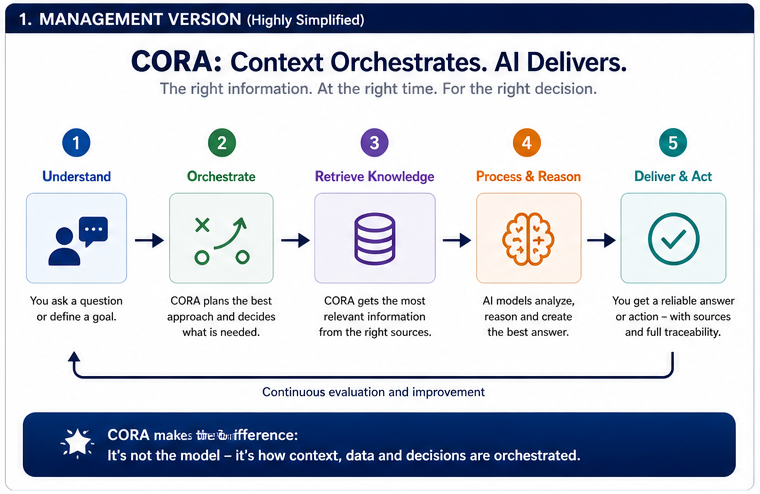
ai-one™ CORA: Context Orchestrates
The right information. At the right time. For the right decision
From input to reliable decision – guided by context, orchestration and control
CORA is an enterprise-wide ai workflow platform that manages the entire journey from data to robust results. At its core is a context-driven architecture that selectively chooses, processes, and verifies information—and reproducibly restores it when needed. The result is auditable, consistent, and decision-relevant outputs, scalable across all use cases.
Product logic: from context to action
CORA begins with structured input (questions, data, documents) and transforms it via a dedicated context engineering layer. Here, knowledge boundaries and scope are defined, content is prioritized, aggregated, and transferred into standardized prompt and workflow structures. Roles, personas, and states ensure that each request is processed in the correct context.
Multi-Source Insight Retrieval
CORA integrates data from local systems (documents, reports, databases), external sources (web, specialist sources), and optionally from enterprise systems (CRM, ERP, APIs). The results are provided as structured insight objects with source, timestamp, confidence level, and metadata. This creates a consistent, traceable information space instead of isolated answers.
Intelligent model usage instead of model dependency
The LLM and analysis layer strategically utilizes different model types – from fast models for simple tasks to complex and multimodal models for demanding analyses. CORA handles routing, cost and latency optimization, ensuring that each task is processed with the appropriate intelligence.
Rollback & Reproducibility (LLM & Data)
CORA extends classic logging approaches with a true historical rollback. Every processing step is versioned and stored in a reconstructible manner:
- Data sets used, including knowledge base
- Retrieval results and sources
- Prompt structures and context composition
- Model type, version, and parameters
- Generated outputs and ratings
This allows for precise tracking at any given time of which decision was made based on which data and model – and for identical reproduction if necessary. Additionally, CORA simulations enable the same question to be re-examined with current knowledge or a new model, and the differences to be analyzed.
CORA fulfils two key requirements in risk management:
- Audit & Compliance: Complete traceability for regulatory and legal requirements
- Business Intelligence: Retrospective analyses and "what-if" scenarios for better decision-making
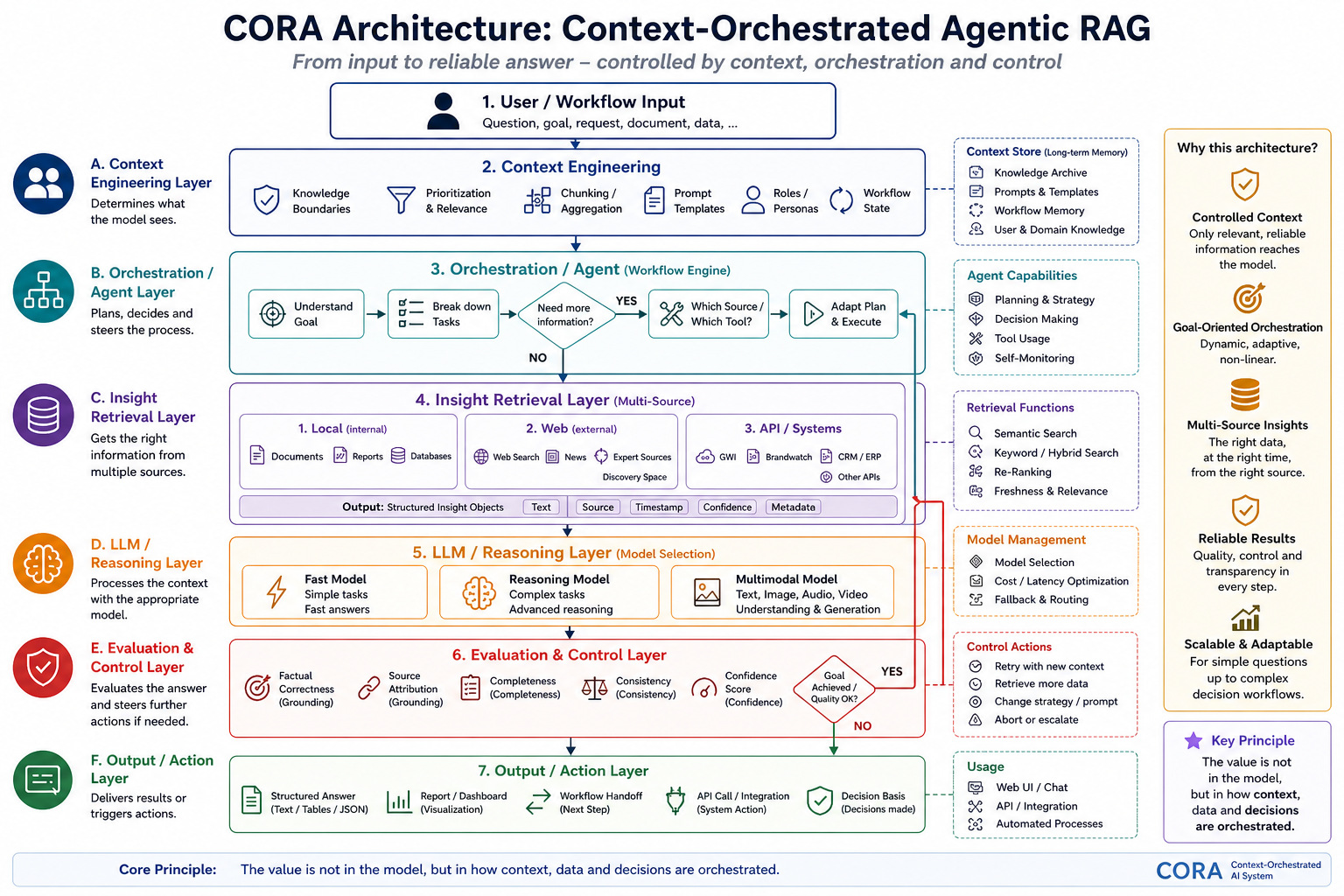
This is an overview of the CORA architecture and its technical and application workflow. It illustrates the individual components – from context definition through orchestration and data acquisition to model processing and quality assurance – and shows how individual workflows are integrated within a controlled overall process. The goal is to derive a reliable, verifiable, and context-based decision or action step by step from a given input.
Key Functions
- Context engineering with clearly defined knowledge boundaries
- Agent-based workflow orchestration with dynamic decision logic
- Multi-source retrieval (internal, web, APIs) with structured insights
- Intelligent model management (routing, costs, performance)
- Integrated evaluation and quality assurance
- Versioned rollback for data, contexts, and LLM execution
- Seamless integration into existing systems and processes
Business Features
- Reliability: Controlled context reduces hallucinations
- Transparency: Answers are traceable and verifiable
- Reproducibility: Every decision can be exactly reproduced
- Compliance-ready: Auditable AI for regulated environments
- Efficiency: Automated analysis and decision preparation
- Scalability: Unified architecture for all use cases
- Competitive advantage: Focus on context, data, and orchestration instead of isolated models
CORA shifts the focus from isolated ai responses to a controlled, orchestrated, and reproducible decision-making process. The crucial value lies not in the model itself, but in the ability to consistently manage context, data, models, and time points – and to be able to restore them at any time.