All images, including CORA, were created using Dall-E, ChatGPT's image generator
Which Chat-Bot do you prefer?
We are at the beginning of a new phase in the IT revolution. Artificial intelligence is developing at an exponential pace, with intelligence, quality, and reliability expected to reach entirely new levels soon. What we see today is only the starting point.
Chatbots are machines based on mathematics and statistics. The central question is: does a human-like or machine-like appearance foster greater trust and acceptance?
In human interaction, trust is shaped not only by words but also by visual signals—facial expressions, gestures, clothing, and overall appearance. These cues help us assess whether someone fits the role of an expert, whether as a doctor, banker, or farmer.
When interacting with a simple text field, such signals are absent, making it more difficult to trust or validate the information. This makes it all the more important to understand the chatbot’s knowledge base and how it has been trained.
Professional use of ai
For companies, the greatest challenge is not the existence of ai itself, but its structured integration into business models and workflows. ai is not a universal solution, it must be precisely designed and applied.
While chatbots are well suited for creative and exploratory tasks such as brainstorming, research, and comparing information, the situation is different in production and operational environments. There, AI must operate under strict rules, optimize processes, support decision-making, and ensure compliance with defined standards such as ISO certifications. In such cases, there is no room for improvisation, ai functions more as a worker and quality controller.
In the business world, ai must therefore be understood as a working tool whose role needs to be carefully defined. In some areas, creativity is required, while in others reliability and rule-based execution are paramount. Companies must therefore determine which type of ai, with which functionality, should be applied at which stage of their processes.
What CORA ai-workflow delivers
ai is not a one-size-fits-all solution. It needs to be designed, structured, and embedded with purpose.
For example:
- A chatbot is perfect for brainstorming, research, and information comparison
- But in production workflows, AI must be precise, rule-driven, and ISO-compliant. Here, creativity takes a back seat, ai’s job is to optimize processes, support decision-making, and ensure flawless execution.
We help companies distinguish between these roles. Some areas require ai to act as a creative partner, others demand ai to be a step-by-step executor.
- Analyse current business cases
- Identify opportunities
- optimise and enhance with ai
- create new value with ai
Implement the
ai solutions with the right functionality, in the right place, within your workflows.
ai that works as a strategic tool, delivering maximum efficiency
ai chats that are already in use by our customers
Until recently, developing and configuring ai chatbots was complex, time-consuming, and expensive. It required specialized software, proprietary databases, and extensive development and integration work. Despite significant investment, the results often fell short of expectations.
With the advent of modern language models like ChatGPT and Claude, this has fundamentally changed. A high-performing ai chat is no longer a technical marvel. The decisive success factor no longer lies in the chat technology itself, but in the quality of the knowledge base. Complete, up-to-date, and reliable data forms the basis for precise, comprehensible, and helpful answers. The better the data foundation, the greater the benefit of the ai chat.
Chatbots als Historiker-Expert:innen für Museen
An ai historian answers questions based on the released historical sources of a museum or archive.
Instead of relying on general internet information, they access curated and verified content, establish connections, place events in chronological order, and present history in an accessible way, tailored to the specific target audience, from schoolchildren to experts.
The ai historian is familiar with the museum's exhibitions, objects, and themes and can point out relevant exhibits.
Their answers spark interest, establish links between the question and the exhibition content, and motivate visitors to visit the museum in person.
Konrad Berg, from the Ortsmuseum Bergdietikon
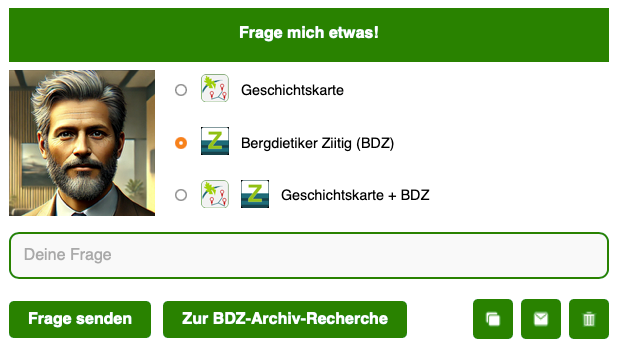
Konrad Berg is the digital ai historian of the Bergdietikon Local Museum.
He answers questions based on publicly available historical sources. He brings history to life through dialogue, explains connections, and communicates knowledge in a way that is understandable and tailored to specific audiences.
From search to dialogue: Chatbots as internal experts
The way we search for and research information is fundamentally changing.
Instead of entering search terms into search engines and sifting through countless results, we communicate directly with an ai system – in natural language.
Questions can be asked precisely, explored in greater depth, and continuously updated. Research thus becomes a dialogue that is faster, more intuitive, and significantly more efficient than traditional searches.
The nature of the results has also changed. Instead of a list of links and short text excerpts, we can, if desired, receive directly structured, summarized, and clearly formulated answers that categorize and connect information from various sources.