Swiss Alps, Overlooking 14K-Foot Peaks
CORA-ai
Cost savings in retirement homes, home care services, and many other nursing and therapy professions
Harmonization of competing and complementary systems
The biggest challenge facing companies and institutions today is not a lack of IT systems, but their diversity. Applications that have evolved over years often compete with each other, even though they should ideally complement one another.
The result is complex IT landscapes with isolated solutions, redundancies, and difficult data exchange.
Especially in healthcare and nursing, digitalization must be simple, intuitive, and time-saving. Documentation is an indispensable part of care today, but it is becoming increasingly complex due to legal requirements and rising demands.
In some situations, it already takes up more time than the actual care of residents or patients.
There are solutions that intelligently connect existing systems instead of creating further complexity. This results in less administrative work, more efficient processes, and more time for what matters most: care and the people.
We work with Amnexis, which distributes the Quixxs App with Quixxs Elevate Desktop.
This is an intelligent solution with interfaces such as Wigasoft's WiCare Now.
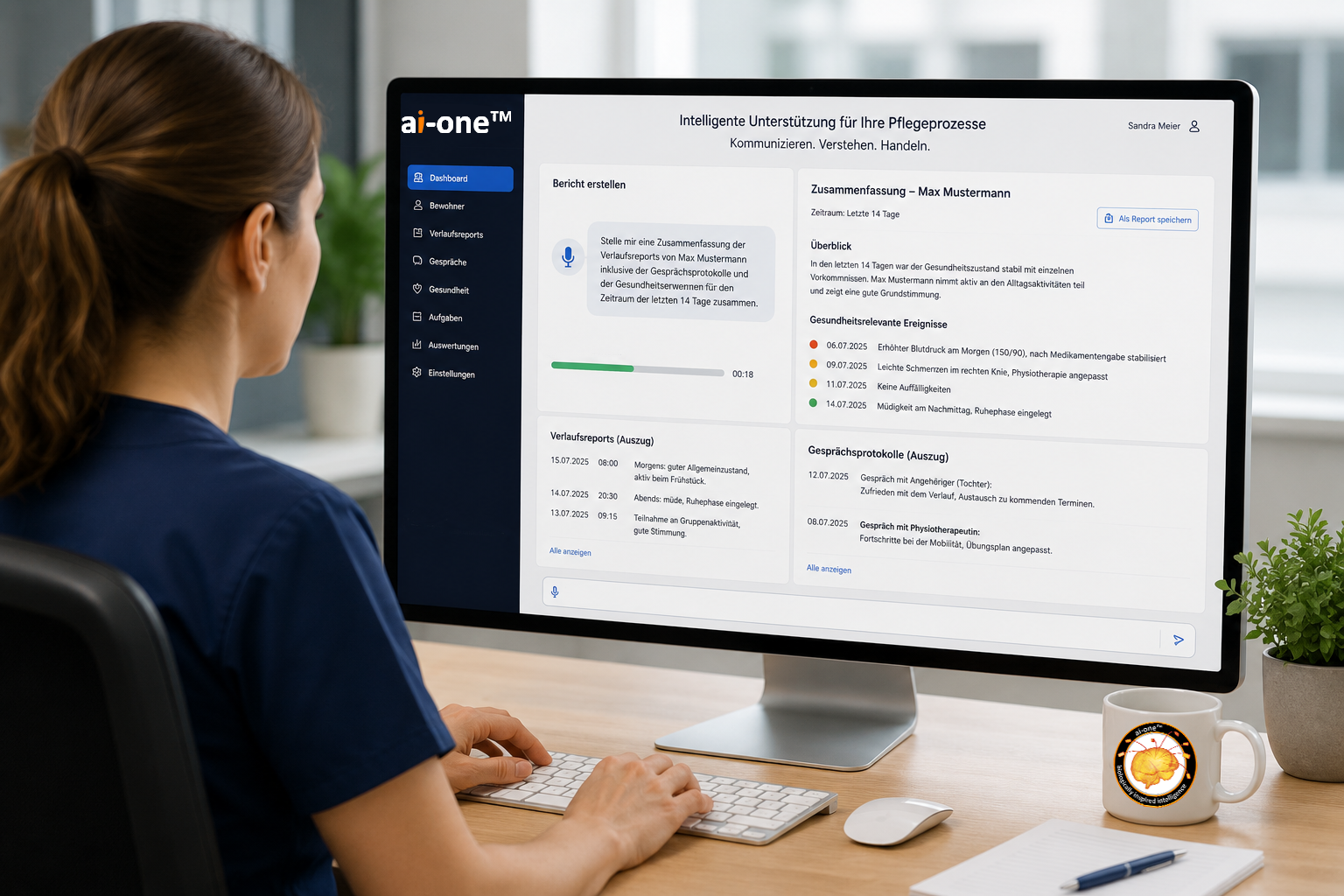
ai-supported: research, reports, analyses, summaries, and much more.
"Create a summary of Max Mustermann's progress reports, including all conversation transcripts and health-related events and measurements (blood pressure, blood sugar, etc.) for the past 14 days."
Creating the report takes less than 30 seconds, even though the data must be gathered from various sources.
Afterward, depending on the circumstances, 1, 2, or a maximum of 3 minutes are sufficient for review, minor corrections, or additions—also conveniently via voice input or keyboard.
Time savings: up to 80% compared to manually creating reports.
Significant cost savings in the evaluations
In healthcare, many processes are standardized or are becoming increasingly standardized. Such processes can be relatively easily translated into structured reports.
However, where people are cared for, much remains individual and unpredictable. Situations change, conversations unfold differently, and special events cannot be forced into fixed templates. This results in a significant workload for individual reports, summaries, and conversation transcripts.
This is precisely where CORA-ai comes in.
Non-standardizable content is efficiently captured, structured, and processed into professional reports in the shortest possible time.
CORA-ai finds and extracts precisely the data and information required for the desired analysis or report, according to your specifications. CORA-ai accesses all available information via interfaces to other applications or by accessing drives, enabling it to deliver a structured, professional report for individuals or groups in a very short time.
Highly precise answers, thanks to controlled and curated proprietary data and expertise.
Optimized source data combined with precise
ai analysis = perfect reports.
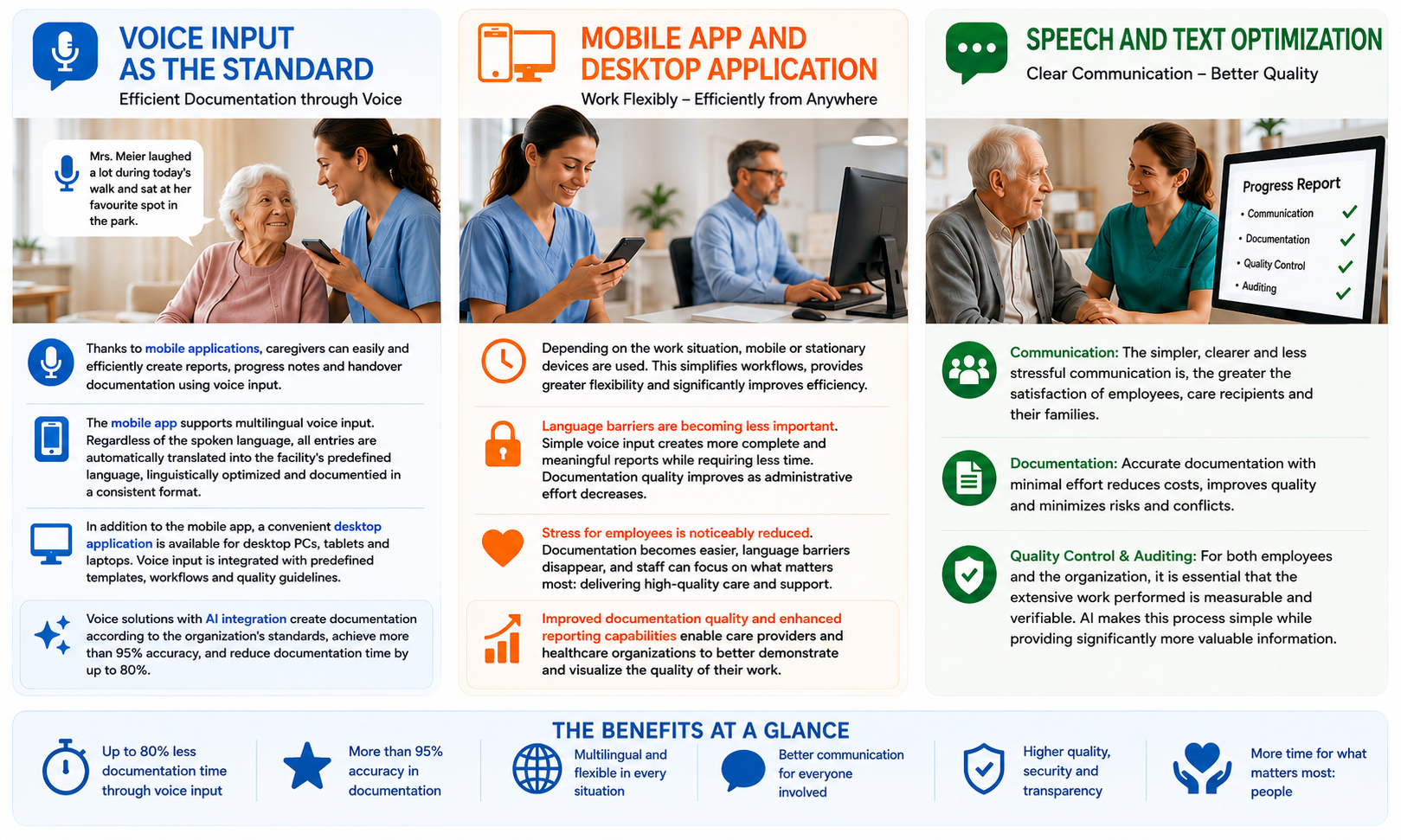
Voice input as default
Thanks to mobile applications, nursing professionals can easily and efficiently create reports, progress documentation, and summaries using voice input.
The mobile app supports multilingual voice input. Regardless of the spoken language, all entries are automatically translated into the defined in-house language, linguistically optimized, and documented consistently.
In addition to the mobile app, a user-friendly dashboard is also available for desktop PCs, tablets, and laptops. Predefined templates, workflows, and quality guidelines are integrated with the voice input.
Reports created with these AI technologies achieve an accuracy of over 95%! This reduces the time required for documentation by up to 80%.
Mobile App as well as Desktop App
Depending on the work situation, mobile or stationary devices are used today. This simplifies workflows, makes them more flexible, and significantly more efficient.
Language barriers become less significant. Thanks to simple voice input, more complete and informative reports are generated while requiring less time. The quality of documentation increases, while the administrative burden decreases.
Stress for employees is noticeably reduced. Documentation is streamlined, language barriers are eliminated, and the focus can revert to what matters most: providing high-quality care and support.
With the improved quality of documentation and expanded reporting capabilities, care facilities can better visualize and present their work and quality standards.
Language and text optimization
In caregiving, it is crucial that caregivers and support staff are professionally well-trained. Equally important is that they speak the language of the organization and the people they care for.
"Communication": The simpler, clearer, and less stressful the communication, the more satisfied staff, those receiving care, and their families will be.
"Documentation": Precise documentation without significant effort reduces costs, increases quality, and minimizes risks and conflicts.
"Quality Control Auditing": For both staff and the organization, it is essential that the enormous amount of work performed is measurable and verifiable. With AI, this is now easily possible and provides more comprehensive information, to the benefit of both the organization and its employees.
The CORA-ai Solution
The Cockpit shares 3 areas:
Left site = Research | Middle = Result visualisation | Right site: Chat/- Text composing
The Research
Research serves two purposes: firstly, to locate specific texts, documents, or content; and secondly, to verify whether a sufficient knowledge base exists on a particular topic.
Additionally, found text passages can be selected and automatically summarized in Quick Mode.
Quick Mode (Summarize Articles/Texts) is especially helpful when creating new content based on existing articles or texts.
Existing information can be efficiently condensed and supplemented with new insights as needed. These additions can then be easily edited and refined directly in the dashboard on the left.
The results / visualisation
The results are displayed in the central area of the cockpit. The layout is customized to the customer's configuration and can vary depending on the use case.
The cockpit is intuitive and easy to use. Results are automatically generated and displayed in a structured format according to the defined prompt and process specifications.
Depending on customer requirements, results can be exported to various formats, such as TXT, Word, or HTML documents.
Alternatively, the cockpit can be directly connected to upstream or downstream systems, allowing results to be processed seamlessly.
The Chat-/ the text composing
The chat input is located on the right side. Depending on the defined workflow, pre-configured prompts are available, which can be used directly or customized as needed.
In addition, you can enter your own text at any time or copy and paste it to supplement or revise existing content or to formulate new tasks.
If the user has the necessary permissions, the chat window can also be used for internet research. In this case, the system operates via the OpenAI interface and offers the same functionality as a licensed ChatGPT version for individuals or businesses. At the same time, CORA's company-specific functions and workflows remain fully intact.
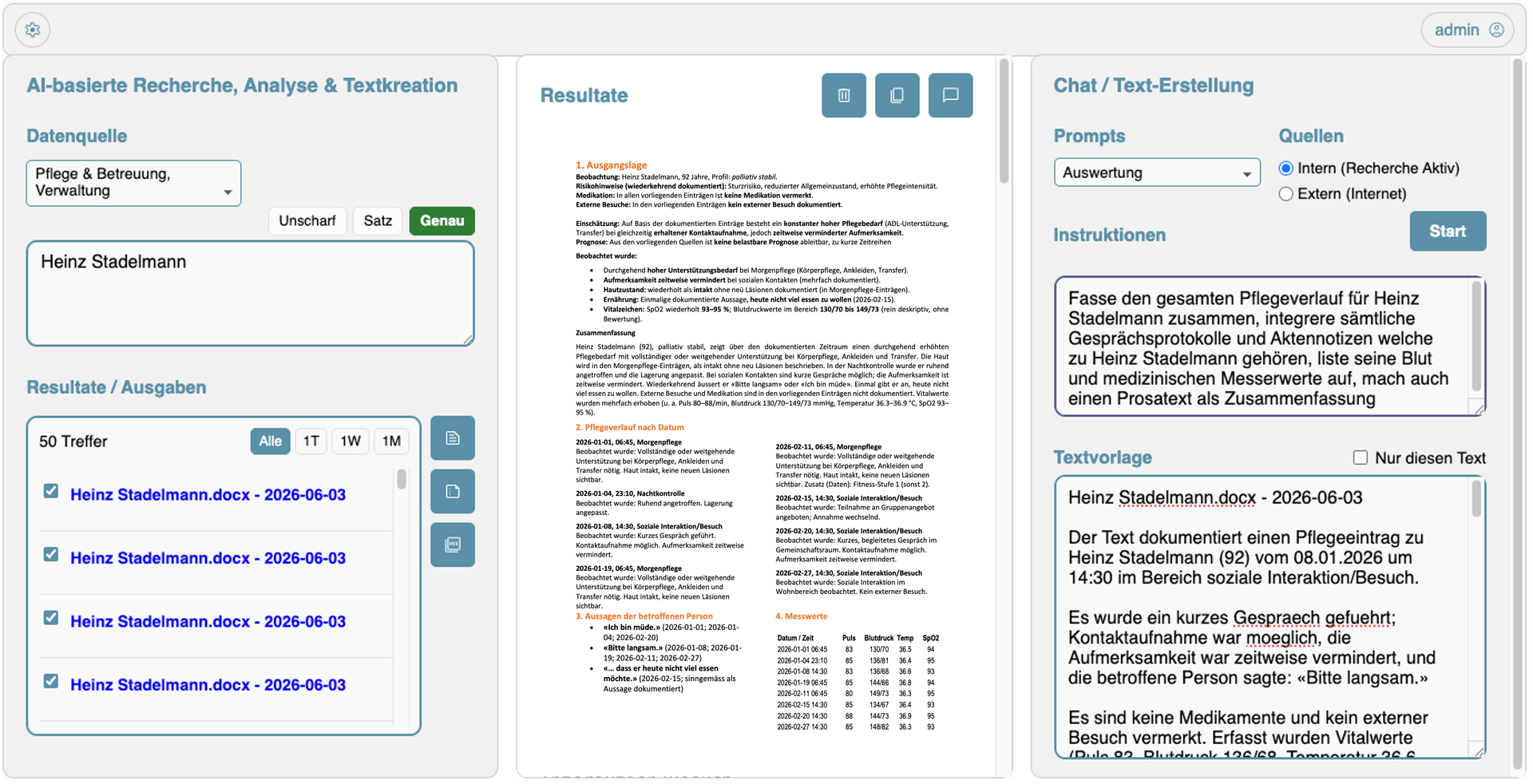
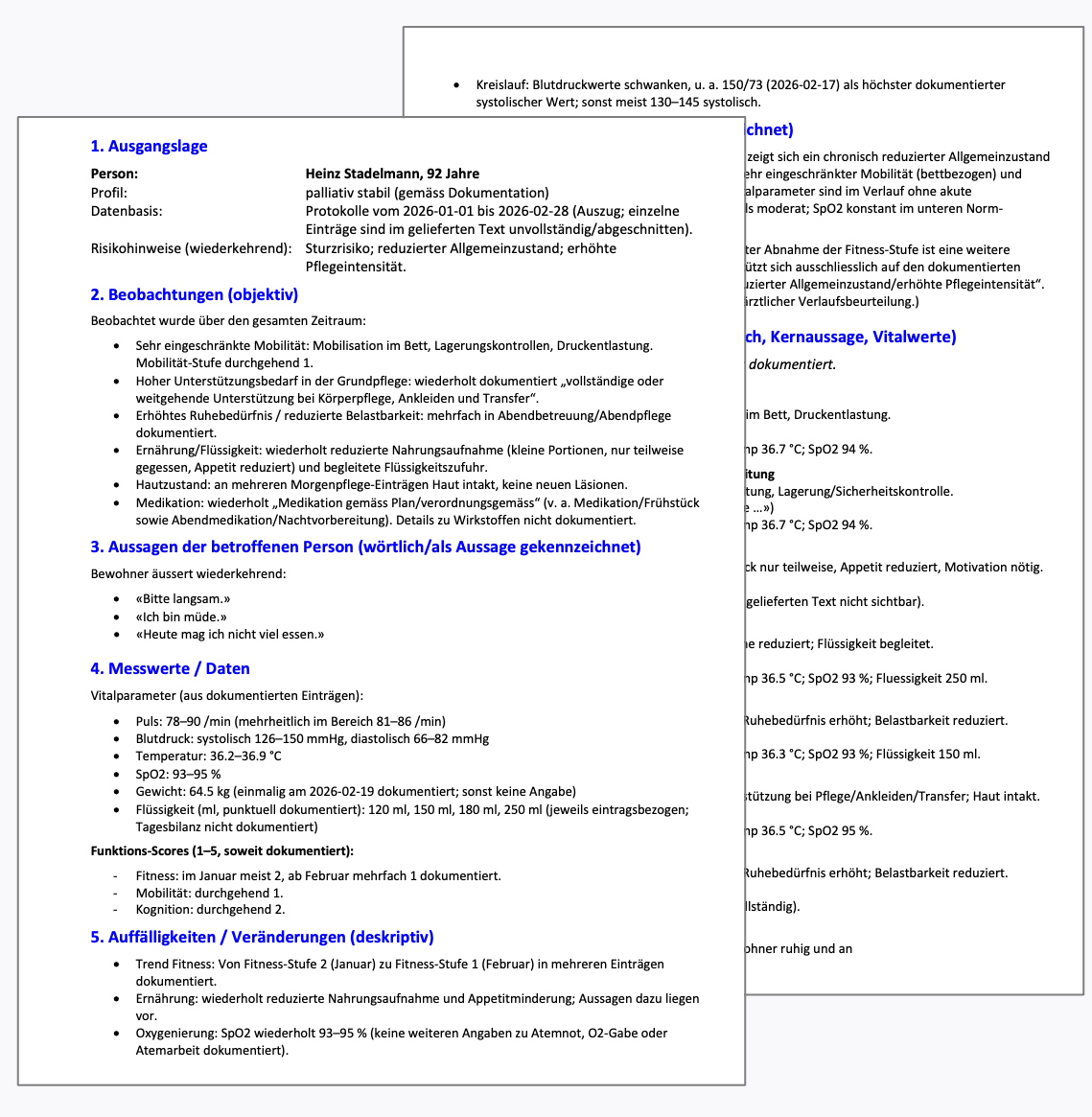
The CORA-ai cockpit
In the left half of the cockpit, the system first researched which information and data were available for creating the desired report. This content was then automatically summarized to verify that the data set was complete and sufficient.
Based on this, the ai received a prompt in the right half of the cockpit to create a new report. The user could then select from various predefined report templates. The ai then automatically generated the report according to the selected specifications and the defined structure.
This research and preparation work for the report took less than two minutes!
Reports
CORA generates the article according to the system and user prompts. Content, structure, and formatting comply with the company's defined standards. Before release, the operator will review the text, make targeted revisions if necessary, and then process it further.
Nothing happens unchecked!
Human oversees, controls, and decides.
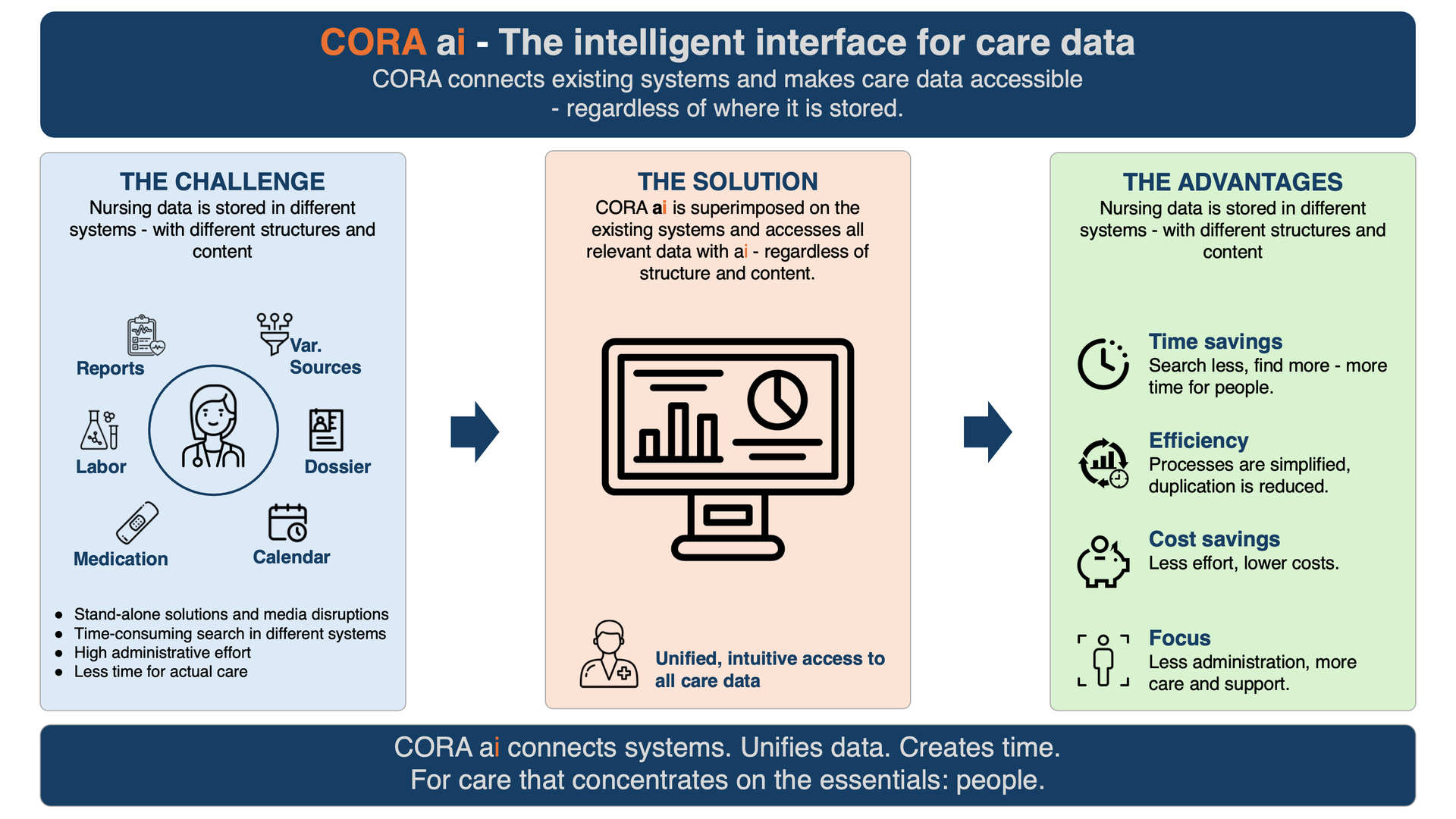
The savings are significant.
For our clients, optimizing existing processes is paramount. The goal is to increase efficiency while simultaneously reducing operating costs sustainably. In many cases, current processes are too complex, too expensive, and tie up valuable human resources.
Since these processes require qualified specialists, savings in personnel costs are limited. Once an organization reaches its minimum staffing level, further cost reductions become virtually impossible.
This leaves only two strategic options in the long term: either reducing or discontinuing individual services, or significantly increasing the productivity of existing employees through new technologies and optimized processes.
This is precisely where the use of ai opens up new possibilities. With the same number of employees, two to three times the workload can be handled, quality improved, and processing time reduced. This allows services to be offered more attractively and at more competitive prices.
The increased capacity leads to additional revenue and sustainably finances the investment in process optimization.
It's not just the cost savings that are crucial; it's also about the new products that become possible. This opens up new customers and markets. It's also about growth.
We have customers who report savings of at least 50%, and in many areas of administration, savings of up to 80%!
How is that possible? - a concrete example
A retirement and nursing home is organizing a trip to a nearby zoo. A total of 25 residents are participating. The event is being organized by a service club and accompanied by volunteers.
This activity must be documented for all participants in their respective activity logs.
In the evening, the responsible nursing staff member receives all relevant information about the trip. First, they record the general section of the report, which is identical for all participants, including details such as the itinerary, the weather, the general mood, and any special events.
After a brief review, they save this general report as a template. They can then add individual notes for each resident via voice input. Experience shows that approximately 20 to 25% of participants require additional personal entries, for example, regarding their well-being, special observations, or individual incidents.
This approach significantly reduces the documentation effort, ensures consistent reporting, and guarantees that all relevant individual information is fully captured in the respective activity logs.
According to feedback received so far, the time required for documentation is reduced by 60 to 80%. At the same time, the quality of the reports improves, as they become more complete, precise, and informative thanks to voice input.