The regulation of artificial intelligence is one of the greatest political, economic and social challenges of our time. How innovation can be promoted while ensuring safety, transparency and accountability is the subject of an international discussion.
We understand the following considerations as a proposal for responsible regulation of artificial intelligence. At the same time, they comply with the principles according to which we would develop our own AI solutions and subject them to a corresponding set of rules and independent certification.
The central question is therefore no longer:
How do we regulate artificial intelligence?
But:
How do we create an international quality standard for the safe and responsible use of artificial intelligence?
Why the classic regulation of artificial intelligence is reaching its limits
The question today is no longer whether artificial intelligence should be regulated, but what can be sensibly regulated at all.
The development of powerful ai models has long since become a global competition. Companies, research institutions and states are developing new systems in ever shorter innovation cycles. Open-source models are spreading worldwide and can increasingly be operated locally. This makes it increasingly difficult to comprehensively regulate the technology itself.
In addition, there is the geopolitical reality.
Even if Europe or other Western countries impose strict regulations, countries such as China or Russia are likely to continue their development with significantly fewer restrictions. Too much regulation can therefore have an effect within one's own legal area, but it does not slow down global development.
On the contrary, it can lead to research, investment and innovation migrating to less regulated regions.
This area of tension is not new. Almost every important key technology – from the printing press and the steam engine to nuclear energy, the Internet and space travel – has prevailed worldwide despite national regulatory attempts. In the end, it was not the technology itself that was regulated, but its application and its impact on society.

This is probably the decisive difference for dealing with artificial intelligence. It will not be possible to control the development of ai in the long term, but its responsible use.
The real challenge is therefore not to prevent innovation, but to embed it in such a way that transparency, security, data protection, traceability and human responsibility are guaranteed.
Europe should not regulate the development of ai, but certify its use
Europe's competitive advantage could lie in the world's most trustworthy ai. Not by developing the largest or fastest models, but by setting an internationally recognized quality standard for transparency, security, traceability and responsibility.
Artificial intelligence is a key global technology. In the long term, their development cannot be stopped either nationally or regionally. As long as individual countries develop and promote powerful ai systems, others will not be able to prevent this progress in the long term through bans or strict requirements. Too much regulation of development therefore carries the risk of pushing research, investment and innovation out of Europe without significantly slowing down global development.
Europe should therefore take a different path. It is not the artificial intelligence itself that should be regulated, but its concrete use. Like the CE marking, it would not prescribe how an ai system must be developed, but what requirements it must meet before it can be used in sensitive areas. It would not be the language model that would be certified, but the entire
ai system with its security, control and documentation mechanisms.
Such regulation could be based on a few, clearly defined basic principles:
- ai Passport: Digital identity of any professional ai system with model version, responsibilities, area of application, and known limitations.
- Audit Log: Audit-proof logging of all relevant decisions, actions and sources used.
- Source: Traceable origin of the information on which answers or decisions are based.
- Verified knowledge spaces: Use of shared and controlled data sources in sensitive applications.
- Role and authorization concepts: Access to information and functions exclusively for authorized persons.
- Independent certification: Standardised tests for transparency, data protection, robustness, traceability, bias, cyber resistance and security.
This would also change international competition. It is not the largest model that wins. It is not the fastest model that wins. The most trustworthy overall system will be decisive.
This could be precisely where Europe's strategic strength could lie. European companies do not necessarily have to develop the most powerful basic models but can use globally available models and develop them into trustworthy solutions through governance, security architecture, documentation and certification.
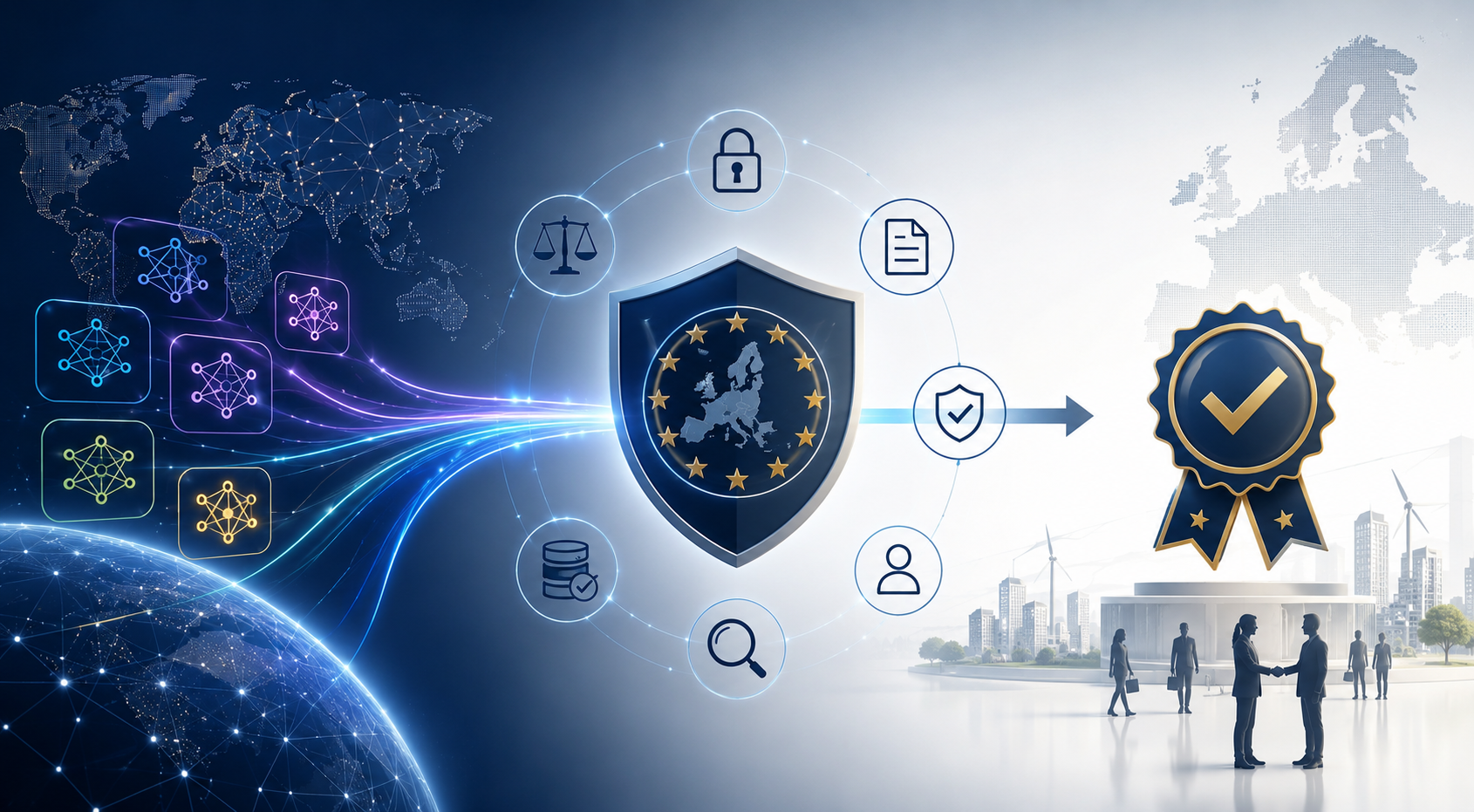
A European seal of approval "Trusted ai – Certified in Europe" would therefore not evaluate the intelligence of an ai, but its trustworthiness. It would confirm that an AI system meets defined requirements for transparency, data protection, security, traceability and human responsibility.
Europe would not try to slow down the development of artificial intelligence but would create a globally recognized quality standard for its responsible use. Innovation would be retained, while protection would be created where risks actually arise – in the application of artificial intelligence.