Swiss Alps, Overlooking 14K-Foot Peaks
CORA-ai
Publishing, marketing campaigns, customer analytics, specialist articles, various types of publications
CORA for publishers – From research to finished article
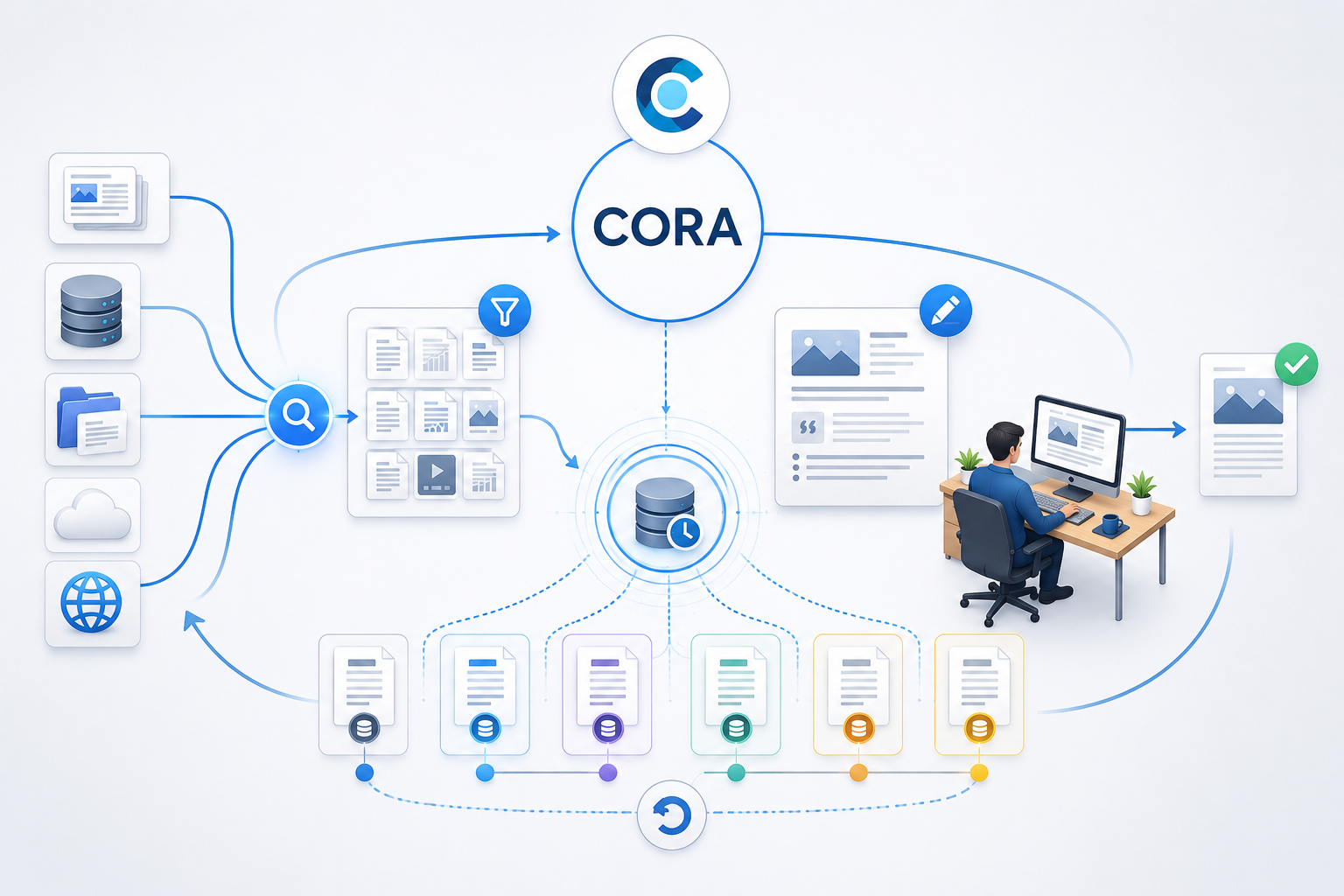
In journalism, the quality of the research determines the quality of the article. CORA helps newsrooms find information faster, evaluate sources effectively, and present complex relationships transparently. Instead of manually searching through countless documents, websites, and databases, CORA compiles relevant information, identifies patterns, links facts, and provides a sound basis for editorial work.
This allows articles to be created much more efficiently. CORA generates drafts, formulates texts in the desired style, adapts content to different target groups, and takes editorial guidelines into account. Whether it's a news item, background report, feature article, or interview, the editorial team retains complete control at all times and decides which content is included or adapted.
The result is faster research, more in-depth articles, greater consistency, and more time for the core journalistic task: researching, evaluating, and telling stories. CORA doesn't replace editors—CORA makes them more productive.
The archive as a publisher's greatest treasure trove of knowledge
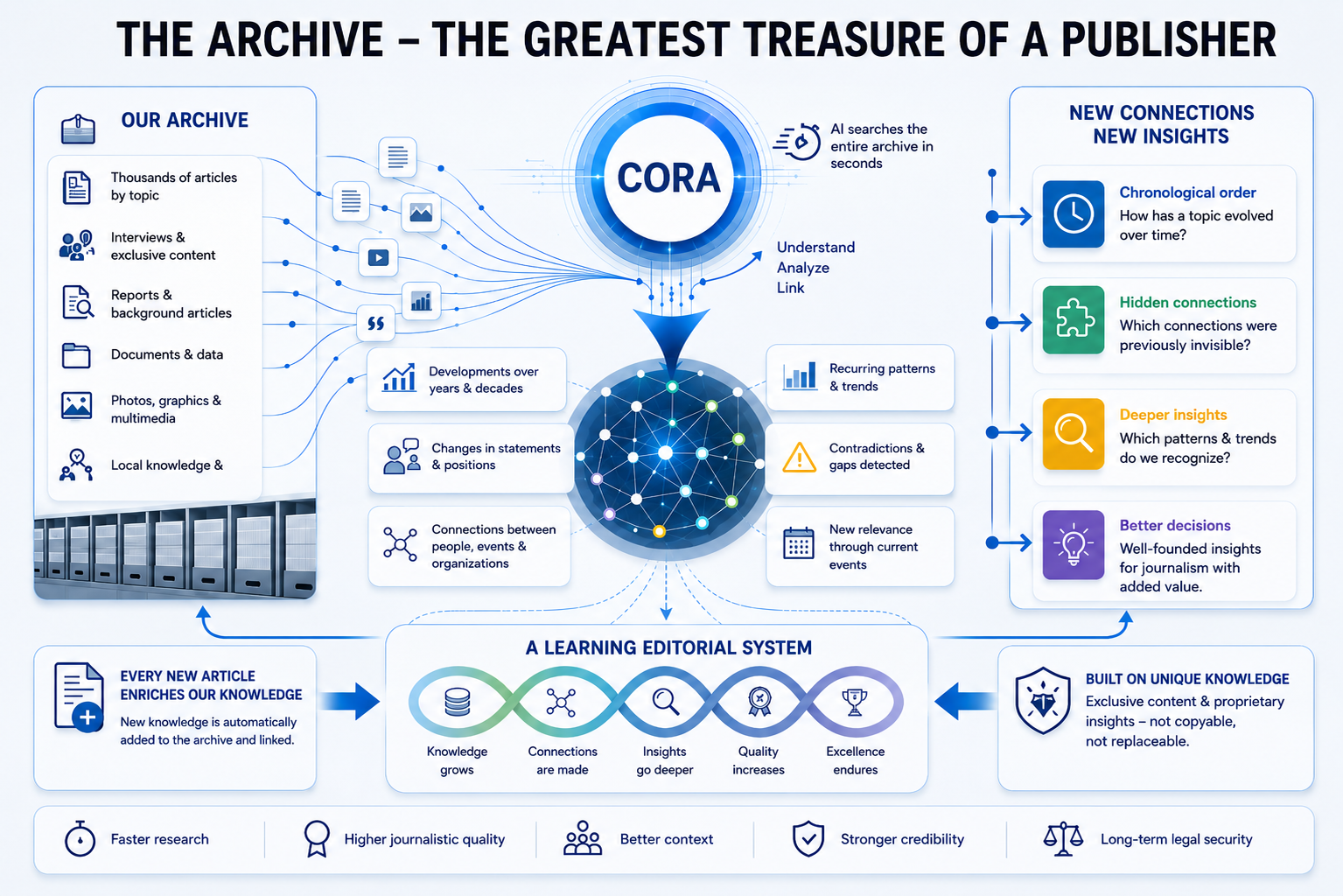
A publisher's most valuable asset isn't just its journalists—it's its archive, built up over years or even decades. Thousands of articles, interviews, reports, background articles, and documents form a unique repository of knowledge that no public search engine can replace.
This archive is invaluable, especially for recurring topics like elections, economics, energy, health, sports, or regional events. CORA makes this wealth of knowledge immediately accessible. Within seconds, the AI searches the entire publisher's archive, finds previous reports, places developments chronologically, identifies connections, and shows how statements, facts, or positions have changed over the years.
This results not only in significantly faster research but also in higher journalistic quality. Instead of starting from scratch each time, the editorial team builds upon the publisher's entire knowledge base. Previous research, exclusive interviews, and original insights are automatically incorporated into new articles, creating an informational advantage that external AI systems or search engines cannot offer.
CORA transforms the publisher's archive from a passive collection of documents into an active source of knowledge. Each new article expands this knowledge and makes the entire collection even more valuable for future research. This creates a learning editorial system where the quality and usefulness of the archive continue to grow with every published article.
The controlled workflow with CORA
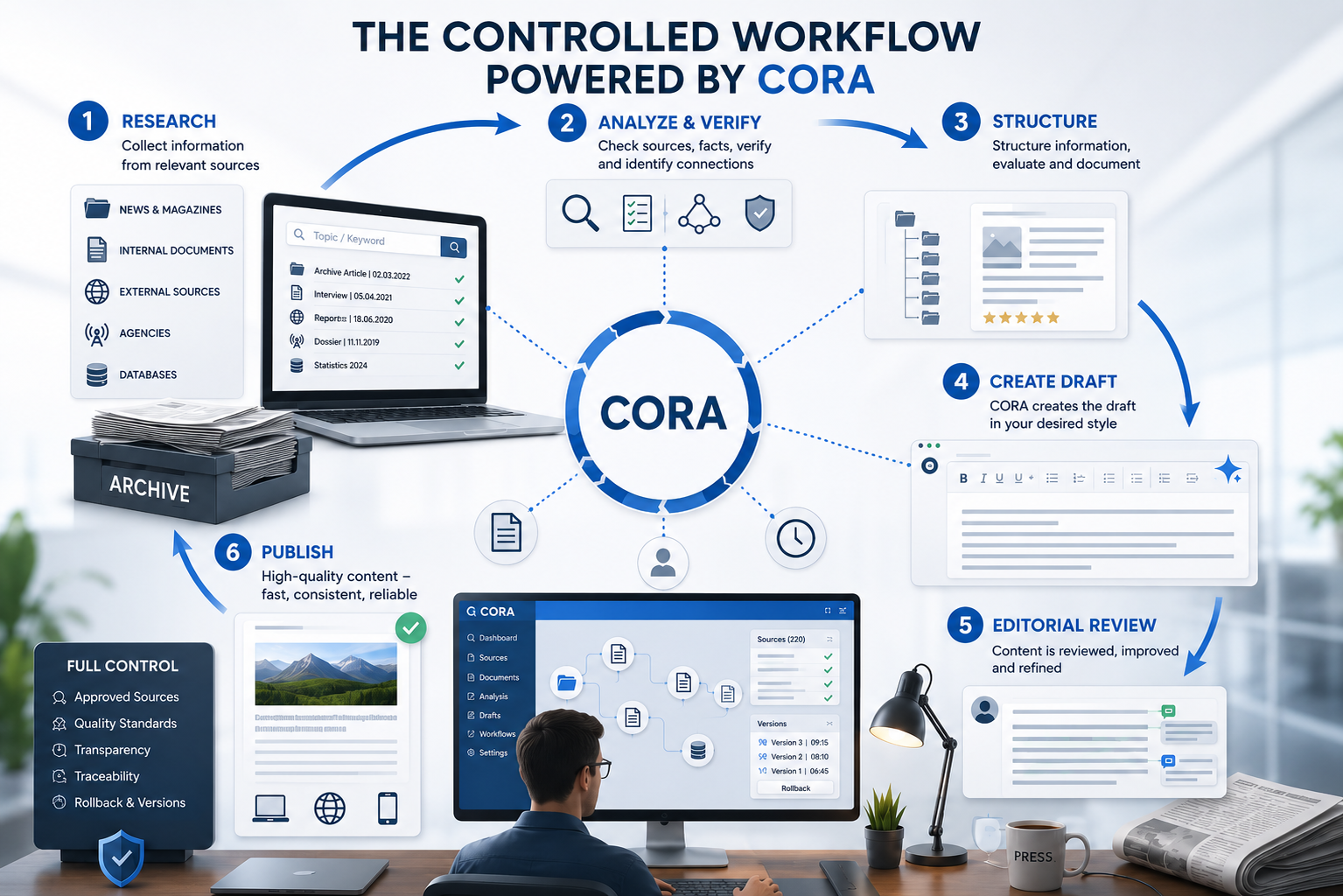
With CORA, the entire editorial process remains under control at all times. From initial research and source analysis to the finished article, every step follows a clearly defined workflow. Information is systematically collected, verified, structured, and documented before being transformed into content.
Editorial teams determine which sources are permitted, which archives are searched, and which quality standards apply. Internal documents, the publisher's archive, agency reports, or selected external sources can be incorporated depending on the task. Every step is traceable and can be reviewed or adjusted at any time.
CORA supports the editor as an intelligent assistant – however, editorial responsibility always remains with the human. Drafts can be supplemented, rewritten, or discarded. This ensures the creation of high-quality articles without relinquishing control over content, sources, or writing style.
The result is a transparent, reproducible, and efficient workflow. Less routine work, more time for research, contextualization, and journalistic quality – while maintaining maximum control over the entire article creation process.
Rollback and full traceability
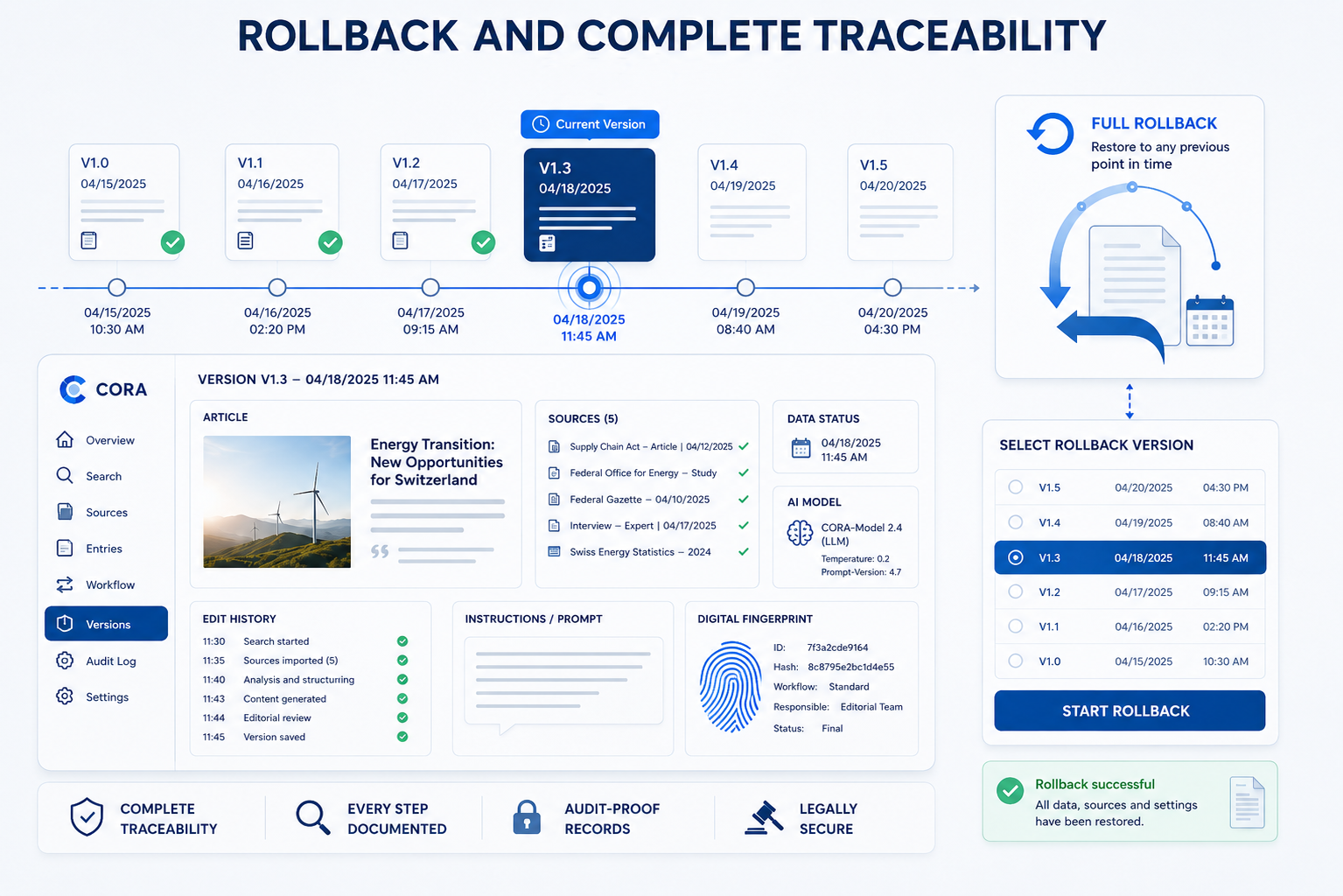
A key advantage of CORA is the complete traceability of every step. For each article, it can be documented which sources were used, which data was available at the time, which AI model was employed, and which instructions were used to create the content.
This allows for a complete rollback at any time. An article can be reproduced or reviewed exactly as it was at the time, using the same sources and the same model. Changes to sources, model updates, or new information do not affect previous versions.
This offers significant advantages, especially for publishers: Editorial decisions remain transparent, statements can be substantiated in the event of inquiries or legal disputes, and the entire creation process of an article is documented in an audit-proof manner.
CORA thus creates a level of transparency that is usually lacking in conventional AI applications. Every article receives a traceable digital fingerprint – consisting of sources, data status, model version, workflow, and processing steps. This enhances quality assurance, strengthens credibility, and provides long-term legal certainty for the publisher.
Publishing, marketing campaigns, customer analyses, factual and technical articles, publications...
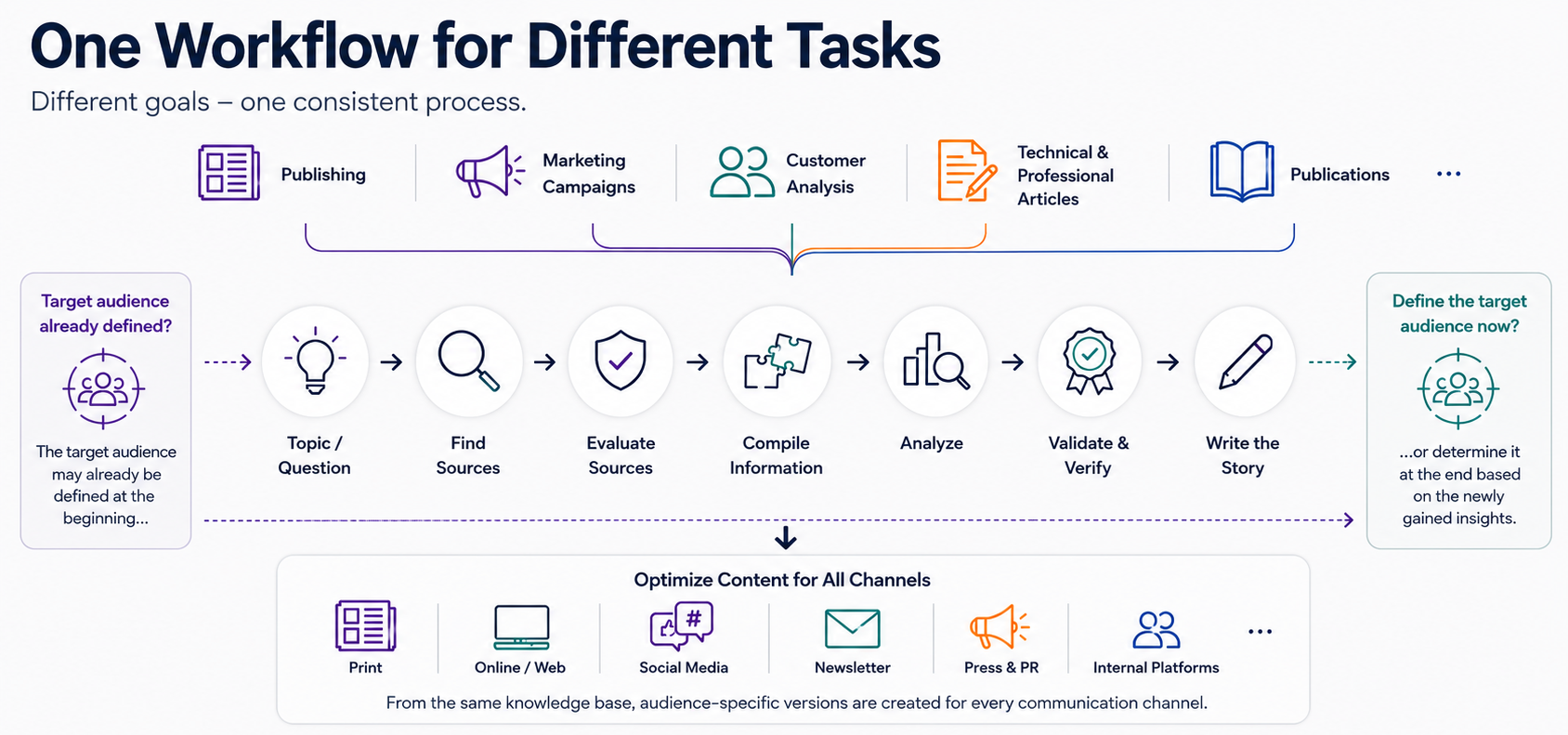
Whether it's an investigative article being researched in journalism, a specialist article being written, new customer segments being identified in marketing, new content being published in corporate communications, or new technologies and findings being presented in specialist publications – the underlying workflow remains essentially the same.
It always begins with a question or a topic. Relevant sources are then found, their quality and credibility assessed, and the information compiled. The content is analyzed, validated, and verified to derive reliable findings. Only then is the actual text created – be it a newspaper article, a white paper, a press release, a marketing campaign, or a scientific publication.
Depending on the use case, the target groups were either defined beforehand or are determined now based on the insights gained.
The content is then optimized for the respective communication channels. Target group-specific versions for print, online, social media, newsletters, or internal communication platforms are created from the same knowledge base. In this way, a single research process yields a multitude of high-quality publications.
CORA accompanies this entire workflow – from initial research through analysis, validation, and verification to final publication. The result is more in-depth content, shorter turnaround times, and significantly greater efficiency, while maintaining full control over sources, quality, writing style, and target audience.
The savings are significant.
Our clients, in particular, prioritize the optimization of existing processes. The goal is to increase efficiency while simultaneously reducing operating costs sustainably. In many cases, current processes are too complex, too expensive, and tie up valuable human resources.
Since these processes must be carried out by qualified specialists, savings in personnel costs are limited. Once an organization has reached its minimum required staffing level, further cost reductions are hardly achievable.
This leaves only two strategic options in the long term: either individual services are reduced or discontinued, or the productivity of existing employees is significantly increased through new technologies and optimized processes.
This is precisely where the use of ai opens up new possibilities. With the same number of employees, two to three times the workload can be handled, quality improved, and processing time reduced. This allows services to be offered more attractively and at more competitive prices.
The increased capacity leads to additional revenue and sustainably finances the investment in process optimization.
It's not just the cost savings that are crucial; it's also about new products that become possible. This opens up new customers and markets. So, it's also about growth.
We have customers who report savings of at least 50%, and in many areas of administration, savings of up to 80%!
How is that possible? - a concrete example
Using CORA significantly reduces the time required for many knowledge-intensive tasks. Research that previously took hours or even days can often be completed within minutes. Information from archives, documents, and shared sources is automatically compiled, analyzed, and presented in a coherent and understandable way.
Significant efficiency gains are also achieved in the creation, revision, and preparation of texts. Drafts, summaries, technical texts, and target-group-oriented versions are produced much faster without sacrificing quality or editorial control. On the contrary, access to all available knowledge makes content more consistent, comprehensive, and well-founded.
Depending on the area of responsibility and existing workflow, organizations report time savings of between 50 and 90 percent. At the same time, the quality of results increases because more sources can be considered, connections can be identified, and content can be systematically reviewed.
However, the real added value lies not only in the time saved. Employees gain the freedom to focus on creative, strategic, and content-intensive tasks—precisely where human experience, expertise, and judgment make the greatest difference. AI doesn't replace these skills, but rather enhances them.
Especially in publishing, the use of AI creates entirely new capabilities. Texts and articles can be efficiently created, revised, and optimized for various publication channels—from print articles and websites to social media, newsletters, and specialist publications. The content remains consistent, while language, length, and style are automatically adapted to the respective target group and channel.